

A softball pitcher should learn how to be an athlete before she becomes a specialized pitcher.
Softball pitching is a highly specialized movement. The windmill delivery requires tremendous coordination, timing, lower-body force production, trunk movement, shoulder motion and sequencing. But because it is an underhand movement, it does not provide the same movement experience as an overhand throw.
Why should you care?
A young athlete can become very good at repeating a pitching motion while still lacking some of the fundamental movement skills required to become a complete throwing athlete.
The windmill pitch and an overhand throw are two very different movement patterns.
During an overhand throw, an athlete has to learn how to organize the lower half, rotate the pelvis, separate the pelvis and trunk, create trunk rotation, sequence the upper body, position the arm and transfer energy from the ground through the body and into the ball.
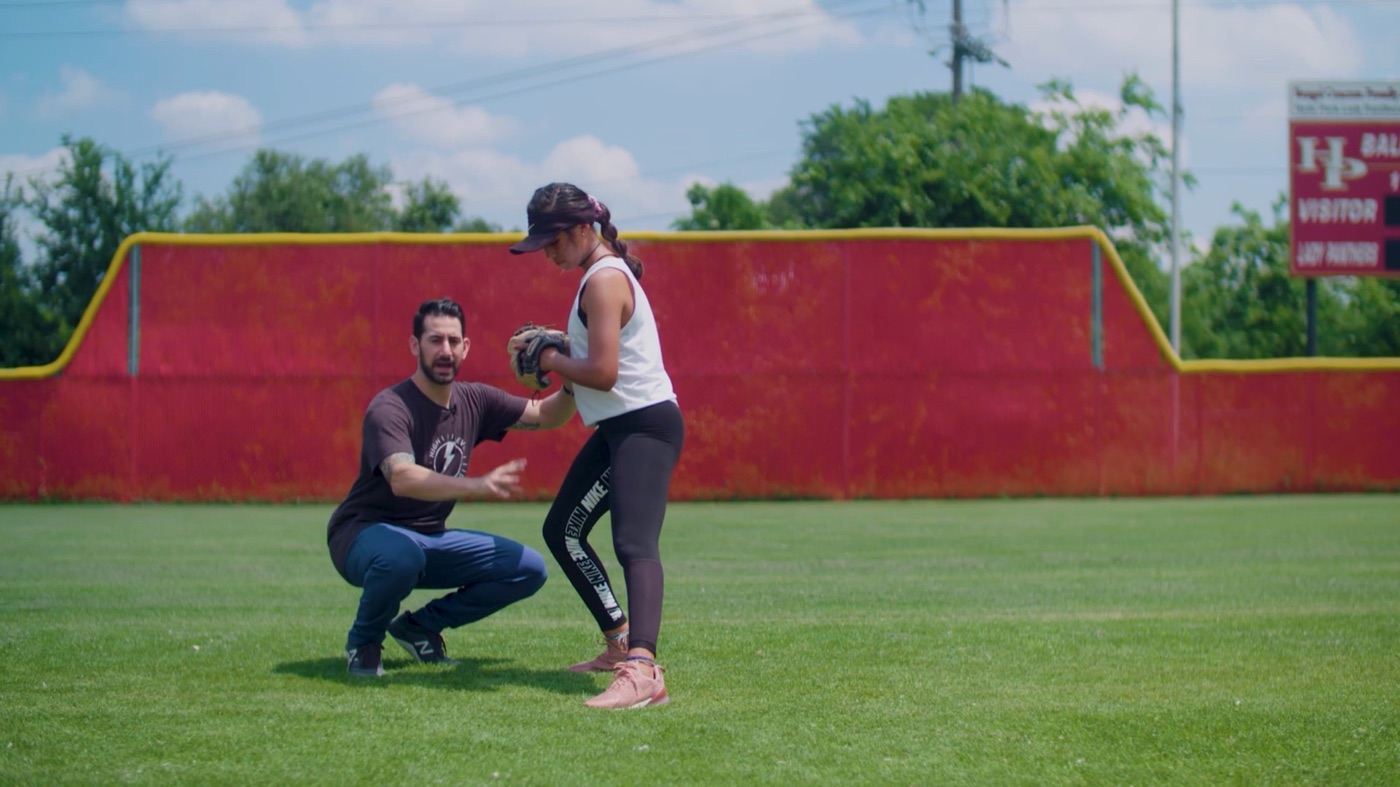
Organizing the throw — lower half, trunk and arm working as one sequence.
That sequence is not simply something an athlete automatically learns because she pitches.
In fact, recent research examining youth softball players during overhand throwing found that younger athletes demonstrated less pelvis-to-arm dissociation, which the researchers associated with reduced energy transfer and lower throwing velocity.
That's important because rotation isn't just about “turning.”
It's about learning when to turn, what turns first, what follows, and how the body transfers energy from one segment to the next.
This is where overhand throwing can help
When a softball pitcher regularly practices quality overhand throwing, she gets exposure to movement demands that are different from her pitching motion.
She has to learn:
- How to use the lower half
- How to rotate the pelvis
- How to separate the pelvis and trunk
- How to use the trunk to transfer energy
- How the arm works in relationship to the body
- How to create and control direction
- How to sequence the kinetic chain
- How to accelerate and decelerate the throwing arm
- How to adjust her movement based on the task
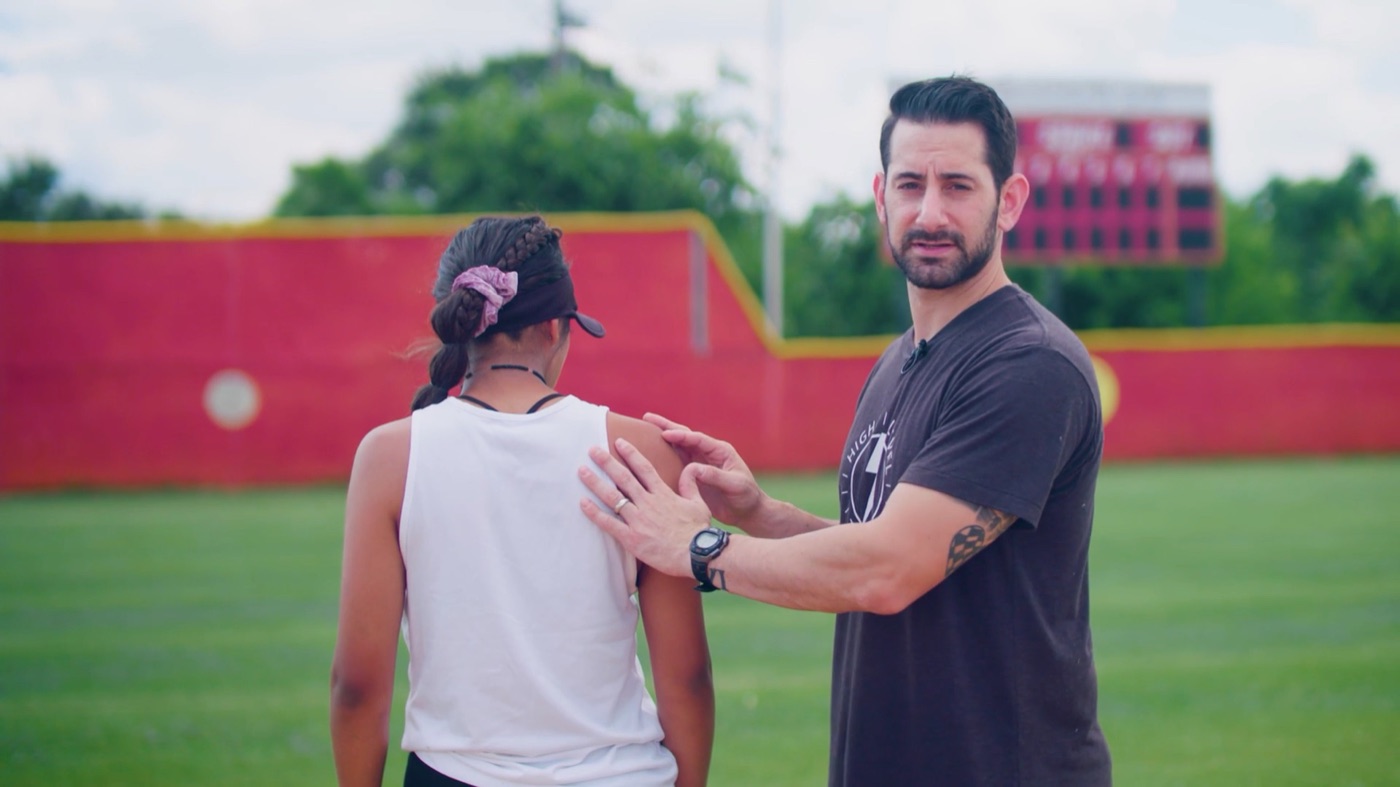
Scapular movement — one of the pieces the windmill delivery never trains the same way.
These are athletic skills—not simply pitching skills.
And they can give an athlete a broader movement vocabulary.
We don't want to rush specialization
One of the biggest mistakes we see is taking a young athlete who shows potential as a pitcher and immediately making everything about pitching.
The athlete becomes very good at one highly specific movement while getting fewer opportunities to develop other important athletic patterns.
Our philosophy is different.
Build the athlete first. Then specialize the athlete.
That doesn't mean young pitchers shouldn't learn how to pitch. It means pitching shouldn't be the only movement they learn.
- A young pitcher can pitch and throw.
- She can pitch and rotate.
- She can pitch and sprint.
- She can pitch and jump.
- She can pitch and learn how to use her lower half.
- She can pitch and develop the ability to move efficiently in multiple directions.
The softball-versus-baseball conversation
We often hear that softball athletes don't rotate as well as baseball athletes.
We don't believe that should be treated as an inherent limitation of female softball players.
There are many reasons an athlete may develop differently—including the movement environments in which she spends her time.
Baseball players generally receive enormous amounts of exposure to overhand throwing from a young age. Position players throw from the outfield, infield, catching positions and on the bases. Throwing is constantly embedded into the sport.
A softball pitcher, on the other hand, can accumulate thousands of repetitions of a highly specialized underhand movement. Having worked with thousands of softball athletes, Austin Wasserman has observed that rotation is more often than not a significant issue. Tapping into that movement is something that needs to be worked on. It's such an important piece of the throwing puzzle.
So the question shouldn't be:
“Why doesn't she rotate like a baseball player?”
The better question is:
“Has she had enough opportunities to learn how to rotate, sequence and throw?”
Don't confuse pitching development with total throwing development
A softball pitcher doesn't need less athletic development because she is a pitcher. She may need more.
Research on softball pitching demonstrates just how complex the windmill motion is and how heavily it relies on the kinetic chain. The pitching motion itself requires substantial lower-body force production and coordinated energy transfer.
But specialization doesn't eliminate the need for general athletic movement. It reinforces it.
An athlete who understands how to move her body, create rotation and transfer energy has more movement tools available to her when she specializes.
Teach the pattern before demanding the performance
This is a major part of High Level Throwing®.
We don't simply want an athlete to throw harder. We want her to understand how her body creates an efficient throwing pattern — practicing it, and then applying those skills to the game.
A pitcher should still learn how to throw overhand, rotate, sequence, move her lower half and coordinate her entire body around the throw.
Don't just develop the pitcher. Develop the whole athlete.