

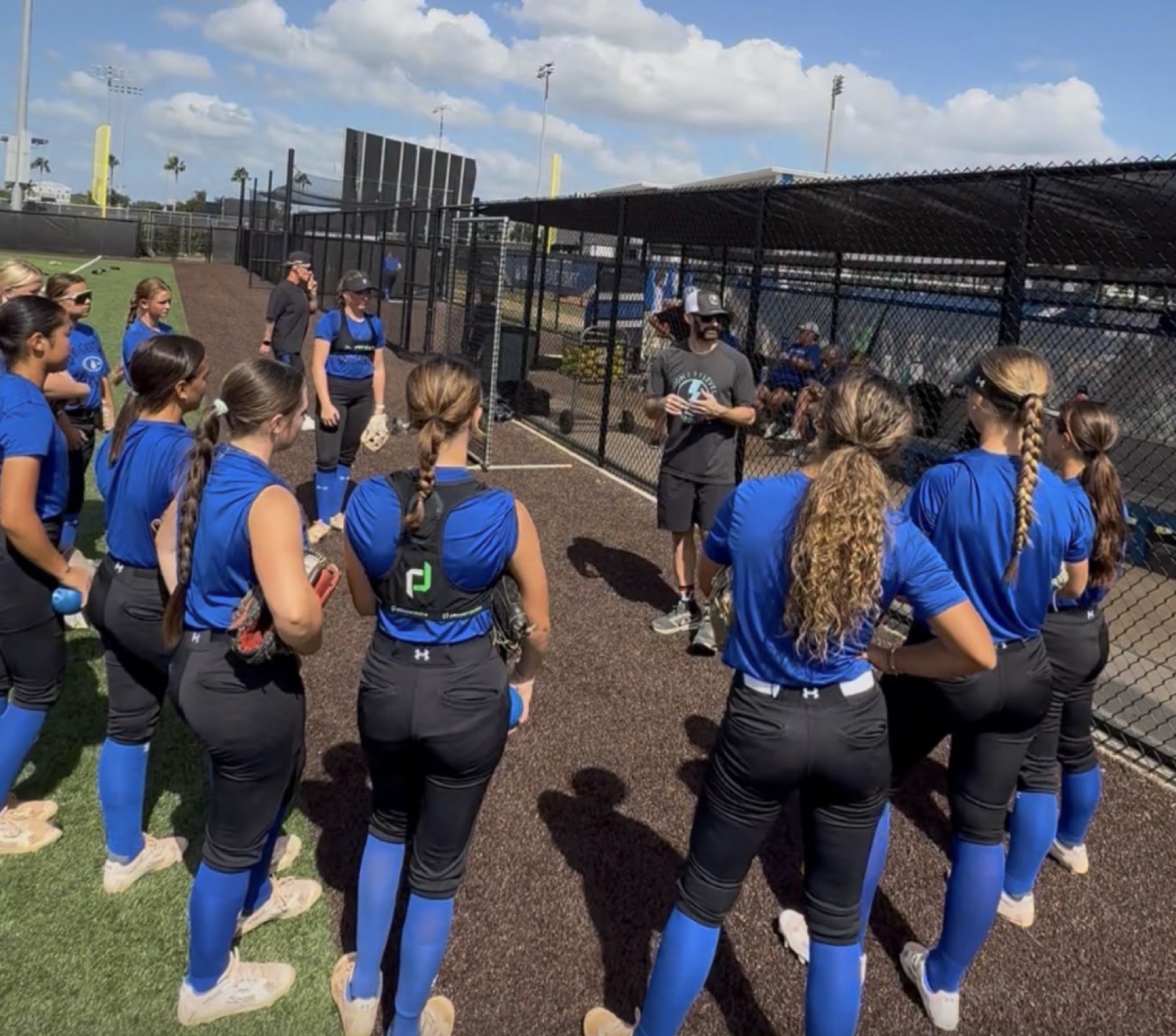
IMG Academy trains athletes who are already good. That is the hard case for any throwing program — it is straightforward to add velocity to someone with obvious inefficiency, and much harder to improve a softball player who already throws well.
The partnership between IMG Academy Softball and High Level Throwing® is built around that reality. Here is what the work actually looked like.
It starts with the staff, not the athletes
The visit opened with a presentation to the coaching staff. That order is deliberate and it is the part most outside groups skip.
A clinician who works only with athletes creates a dependency: the athletes learn something, the staff watches, and when the visitor leaves nobody in the building can coach it. Starting with the staff means the people who are there every day understand what is being taught and why before a single athlete picks up a ball.
On-site, hands-on, with the full roster
The on-site work ran hands-on with the whole roster — not a demo in front of a group, but instruction with athletes throwing and getting corrected in real time.
From there it broke down by position. A shortstop, a corner outfielder, a pitcher and a catcher do not throw the same way: they start from different positions, under different time constraints, to different distances. Working the full roster first establishes the shared movement principles; splitting by position afterward is where those principles become usable in a game.
Every player left with her own assessment
Each athlete was captured on video and received an individual throwing assessment — her own, not a roster-wide summary.
That matters more than a velocity number on its own. Two athletes throwing the same speed can have completely different reasons for being stuck there, and completely different work to do about it. A single group recommendation would be wrong for most of the roster.
Alongside the assessments, every player received arm care and throwing guides. Distributing them per athlete rather than handing the staff one master copy is what makes the work survive after the visit — each player has the material for her own arm, in her own hands.
Why arm care gets its own document
The arm care guide is separate from the throwing guide on purpose. The warm-up is the part that happens every single day, including the days with no throwing work, including game days, including the days nobody feels like doing extra.
Arm care only does anything if it is boring and constant. Writing it as its own document, rather than a preamble to the training, is what makes it something a program can actually enforce.
Why the structure is built for the staff
The thing that makes college throwing development work is not the visit. It is the hundreds of sessions that happen afterward, run by the people who are there every day.
Everything above is designed so the program owns it: the staff was taught first, the athletes were coached hands-on, the arm care stands on its own, and every player holds her own assessment and guides. We are not in the building in February. The material is — and so are the coaches who sat through the presentation.
If you run a program
The same structure scales down. A travel organization or a high school softball program does not need an academy's resources to teach the staff first, train throwing by position, keep arm care consistent, and measure overhand throwing velocity often enough to know whether any of it is working.
Bring a High Level Throwing® clinic to your program →
College consulting and program partnerships →